



| ΩΡΕΣ ΛΕΙΤΟΥΡΓΙΑΣ: | Τετάρτη 10:00-20:00 |
| Πέμπτη - Κυριακή 10:00-17:00 | |
| Δευτέρα & Τρίτη κλειστά |
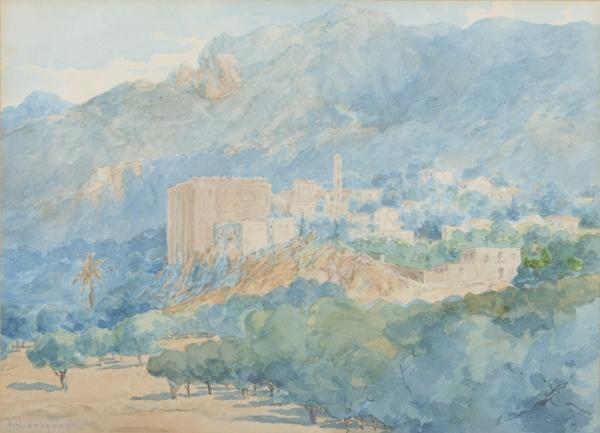
From the 18th century, painter-travellers showed particular interest in the depiction of Cypriot landscapes and landmarks, as well as in the painterly rendition of the island’s ancient and medieval monuments, using principally the artistic medium of watercolour. This tendency was reinforced with the arrival of the British on the island in 1878. Watercolours proved ideal for painting from nature. Landscape artists could easily carry their materials. Furthermore, the diluted colours dried immediately and so were amenable to subsequent layers. Driven by the excitement of discovering new, different, even – to their eyes – ‘exotic’ places, they portrayed their subject matter with a romantic slant, accentuating its picturesque quality or, in some cases, focusing their interest on precise description, primarily of archaeological sites.
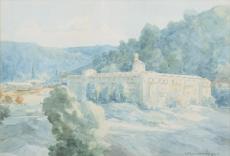
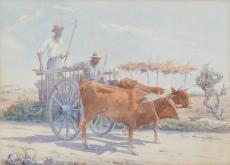
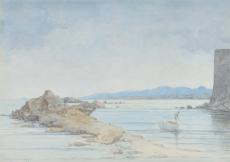
First among the Cypriot artists to adopt the traveller’s gaze of foreign artists was Ioannis Kissonerghis, painting many of the ancient, medieval and later monuments of Cyprus. The A. G. Leventis Gallery Collection includes four such characteristic landscapes.All four are seen from a distance, in order to underscore their panoramic viewing.
The artwork, Bellapais Abbey, is rendered perched on the slopes of the Pentadaktylos Mountains, looking down upon the edge of the village of the same name. Perched on one of the sheer mountain tops of the same range stands St Hilarion Castle, built by the Byzantines in the 11th century and then used by the Franks, who modified it to meet their own needs.
By rendering all the details that make up the buildings’ architectural physiognomy, as well as that of the tree-covered mountain region, he gave, through his studied management of the light, the atmospheric character of the natural space of Cyprus.


Ioannis Kissonerghis was born in Nicosia in 1889. He studied medicine for three years at the University of Athens, but interrupted his studies to take part in the Balkan Wars. After they ended in 1913 he enrolled in the Athens School of Fine Arts, where he remained for 1 ½ years. However due to serious Illness, he had to return to Cyprus, where he taught at the Pancyprian Gymansium and The English School. His art was very much influenced by his studies at the Athens School of Fine Art, where he was taught by professors that had been educated in Munich and had brought with them the artistic climate that prevailed there at the time. His relationship with them is evident in Kissonerghis’ realistic approach, accomplished draftsmanship and detailed and skillful composition. Kissonerghis was particularly involved in watercolour. The greater freedom of line and the quicker speed that watercolour painting demands affected his style, helping to distance him from the various constraints of the academic tradition.
 Ιστορικό